Enterprise bargaining has become more complex and more volatile.
Recent changes to the intractable bargaining framework mean that when negotiations stall, the pathway forward is no longer just continued discussion or industrial pressure. There is now a clearer mechanism for matters to be escalated and ultimately determined.
That shift changes the dynamics of bargaining in a very real way.
What was once a process driven largely by negotiation and leverage is now one where the Fair Work Commission can step in and effectively bring the process to an end.
What has actually changed
Intractable bargaining orders are not new, but the way they are now being used and the context around them has evolved.
Where bargaining reaches a point of genuine deadlock, parties can apply to the Fair Work Commission for an intractable bargaining declaration. Once granted, the Commission has the power to move toward arbitrating the outcome.
In practical terms, that means:
- the negotiation phase can be cut short
- unresolved issues may be determined externally
- control over the final position shifts away from the parties
This is a significant departure from traditional bargaining dynamics, where outcomes were almost always the result of agreement between parties, even if reached under pressure.
The fundamental shift is that EA outcomes will be determined rather than lay dormant and the Fair Work Commission’s role is to be solutions focused to push the parties to an outcome.
Why this matters for employers
For many businesses, bargaining strategy has historically been built around endurance and leverage.
Holding position, weathering the industrial pressure and then pushing for an agreement when the timing was most favourable.
That approach is now riskier under the new framework as the control of the bargaining process could be lost.
Once a matter moves toward intractable bargaining, the ability to control timing, messaging, and ultimately the outcome becomes more limited. Decisions may be imposed rather than negotiated.
Where escalation is happening faster
One of the key shifts we are seeing is the speed at which bargaining can move from negotiation into escalation.
Early signals include:
- limited movement across multiple bargaining rounds
- entrenched positions with little room for compromise
- increasing formality in communication
- earlier consideration of Commission pathways
In this environment, escalation is not a last resort. It is becoming part of the strategy.
That means businesses need to be thinking about it much earlier in the process.
The role of structure and strategy
This is where many organisations are being caught out.
Preparation tends to focus on:
- claims and counterclaims
- financial modelling
- benchmarking
But less attention is given to:
- escalation pathways
- decision making thresholds
- alignment across leadership
- what happens if the matter leaves the negotiation table
Without that structure, responses become reactive.
And in a framework where escalation can lead to externally determined outcomes, reactive decision making carries real risk.
Understanding the escalation pathway
Bargaining is no longer a linear process.
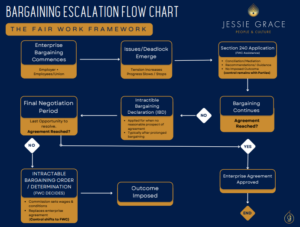
It is a staged progression, with defined points where matters can shift from negotiation into formal mechanisms, including applications to the Commission and, ultimately, intractable bargaining declarations.
The escalation flowchart below outlines this progression and highlights the key decision points along the way.
The value of this is not just understanding the process, but anticipating it.
When leadership teams have clarity on:
- where they are in the process
- what triggers the next stage
- and what their position is at each point
they are far better placed to manage both risk and outcome.
What good looks like now
In the current environment, effective bargaining requires more than a strong commercial position.
It requires:
- early alignment on strategy, including escalation scenarios
- disciplined and consistent communication
- clear ownership of decision making
- ongoing reassessment as bargaining progresses
Importantly, it requires a shift in mindset.
Bargaining is no longer just about reaching agreement.
It is about managing the process in a way that protects your position, even if the outcome is ultimately determined externally.
A practical sense check
If you are entering a bargaining cycle, or already in one, it is worth asking:
- Are we prepared for escalation, or assuming we will resolve through negotiation?
- Do we understand our position if the matter moves toward arbitration?
- Are our leadership team aligned on thresholds and decision making?
- Do we have a clear view of the process, not just the outcome?
These questions are becoming increasingly important as the landscape shifts.
The JG view
The introduction and increased use of intractable bargaining orders represents a fundamental shift in how enterprise bargaining operates.
It reduces the certainty that outcomes will be negotiated and increases the likelihood that unresolved matters may be determined externally.
For employers, this reinforces the need for structure, alignment, and proactive strategy from the outset.
Those who adapt to this shift will be better positioned to manage both the process and the outcome.
Those who do not risk being caught reacting to a system that is no longer operating the way it once did.
The impact of a poorly negotiated EA hits businesses both short and long term. From a short term perspective the decision could be made outside of the organisation. The longer lasting impact can breakdown your workplace culture where values are no longer aligned, collaboration is limited and productivity lacks in motivation and effort.